Today’s topic arrived from a reader who practices regularly at the supreme court (and prefers to remain anonymous). The question—said to be widespread among seasoned appellate attorneys—stems from their impression that the court is taking an unusually long time to process petitions for review. I am grateful for research suggestions, and in this instance we can make some headway.
Most supreme court cases involve consideration of decisions from the Court of Appeals. Specifically, once the Court of Appeals has issued an opinion, a dissatisfied party may choose to file a petition for review with the supreme court. These petitions are assigned to the court’s commissioners who, according to the court’s internal operating procedures, have 50 days to present a memorandum to the justices explaining the commissioner’s assessment of a petition’s merits. Once the justices have discussed the matter, an affirmative vote from at least three of them suffices to grant the petition.
Our focus concerns the number of days between the submission of a petition for review and the court’s decision to accept the case (that is, grant the petition). After determining the number of days between submission and grant for each case decided by the justices—and omitting the small number[1] of cases that skirted the Court of Appeals—we find that the median period between submission and grant in 2024-25 was 129 days.[2] This is almost exactly the same as the 127-day median for cases decided, or awaiting decision, in the 2025-26 term.[3]
Through a comparison of these nearly identical medians for 2024-25 and 2025-26 with those for the five preceding terms, an answer emerges to the reader’s question. The court is indeed taking longer—by over a month—to grant petitions for review, as illustrated in the following chart.

The reasons for this are unclear. One might guess, for instance, that the court has been swamped of late by a surge of petitions for review, overwhelming the commissioners with more work than they can handle efficiently. However, such has not been the case. As shown in the chart below, the court received far more petitions in 2020-21 and 2021-22 than in 2024-25 (or, to date,[4] in 2025-26).

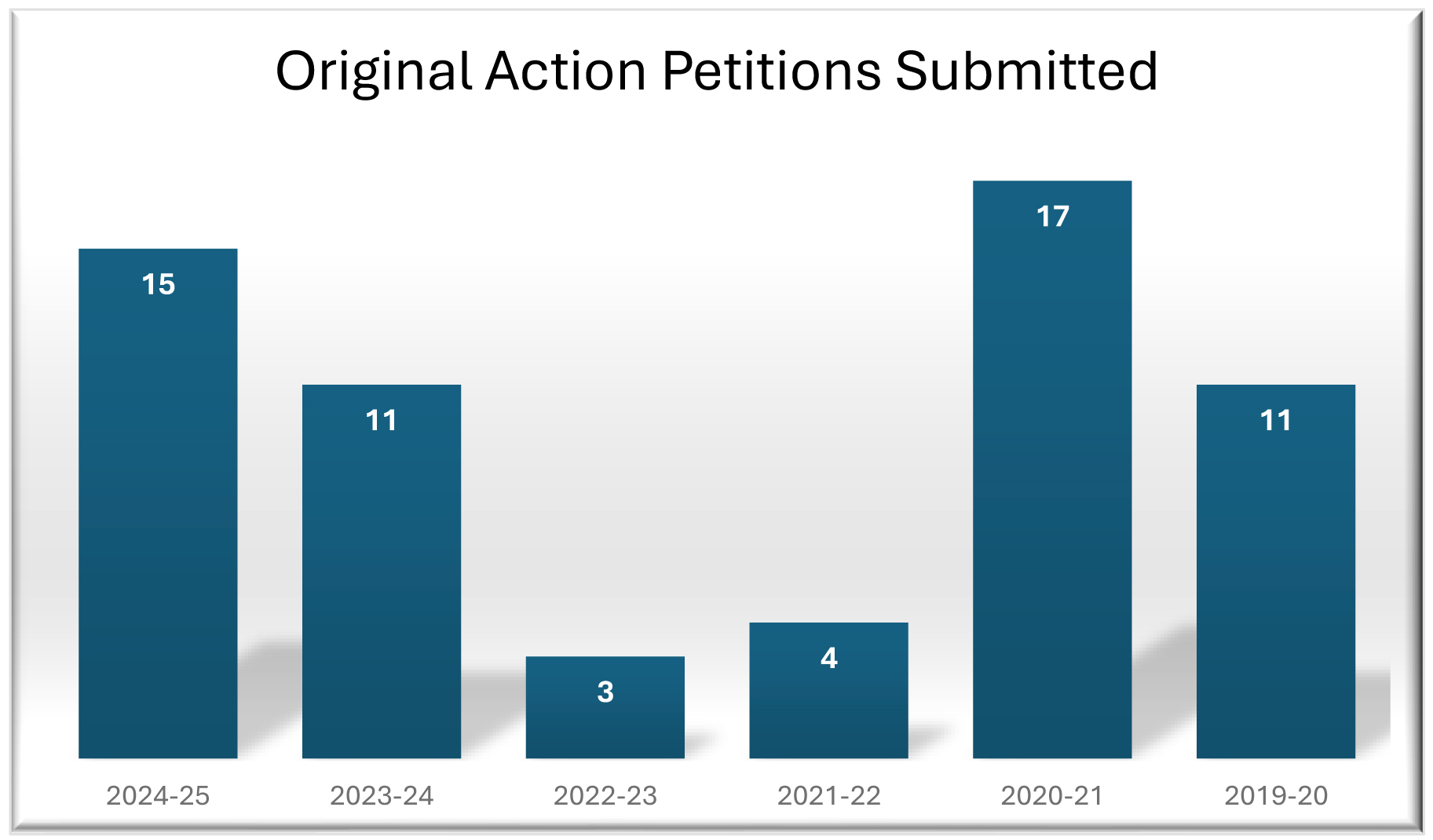
Readers have also wondered whether an unusual volume of “original actions” has factored in delaying ordinary appeals. Litigants who file petitions for original action often assert urgency of some sort—related, for example, to a public health threat or an election—and request that their cases advance directly to the supreme court, skipping the lower courts entirely. Such petitions, by requiring priority attention from the commissioners,[5] impede consideration of regular petitions seeking review of decisions from the court of appeals.
The next chart lends some support to this speculation, as substantially more original action petitions were filed in 2024-25 than in the three preceding years.[6] But 2020-21 raises a problem. During that term the court received more original action petitions than in 2024-25—and many more standard petitions for review—yet still managed to process grants more rapidly.
No doubt something else contributed to the slowdown noted by the reader who posed our question. Perhaps turnover among the court commissioners has played a part, triggered by the retirement of a commissioner with decades of experience. As always, I welcome hypotheses on this score from others.
[1] Our study does not include the smaller volume of cases that reached the justices more directly—generally on bypass, certification, or as original actions. Also excluded are a tiny number of cases deadlocked by 3-3 votes or dismissed as improvidently granted.
[2] Cases are assigned to terms according to the date when the ultimate decision was filed (not according to the submit or grant dates of the petitions for review).
[3] Medians are used here, rather than means, because they resist distortion from single outliers, as when the court takes an enormous number of days to grant a petition.
[4] According to the court’s website, 357 petitions for review have been filed as of March for the 2025-26 term.
[5] Cases that reach the supreme court via petitions to bypass the court of appeals or on certification from the court of appeals also generally receive priority over regular petitions for review. Here is a table displaying the number of such cases.
[6] Through the end of April, nine original action petitions have been filed during the 2025-26 term.
 About Alan Ball






Speak Your Mind