When Janet Protasiewicz joined the bench for the 2023-24 term, the court entered an unparalleled period of liberal control that produced voting patterns conspicuously different from those of previous years. Some of this continued in 2025-26—but with significant alterations, as we shall see.
Bloc cohesion
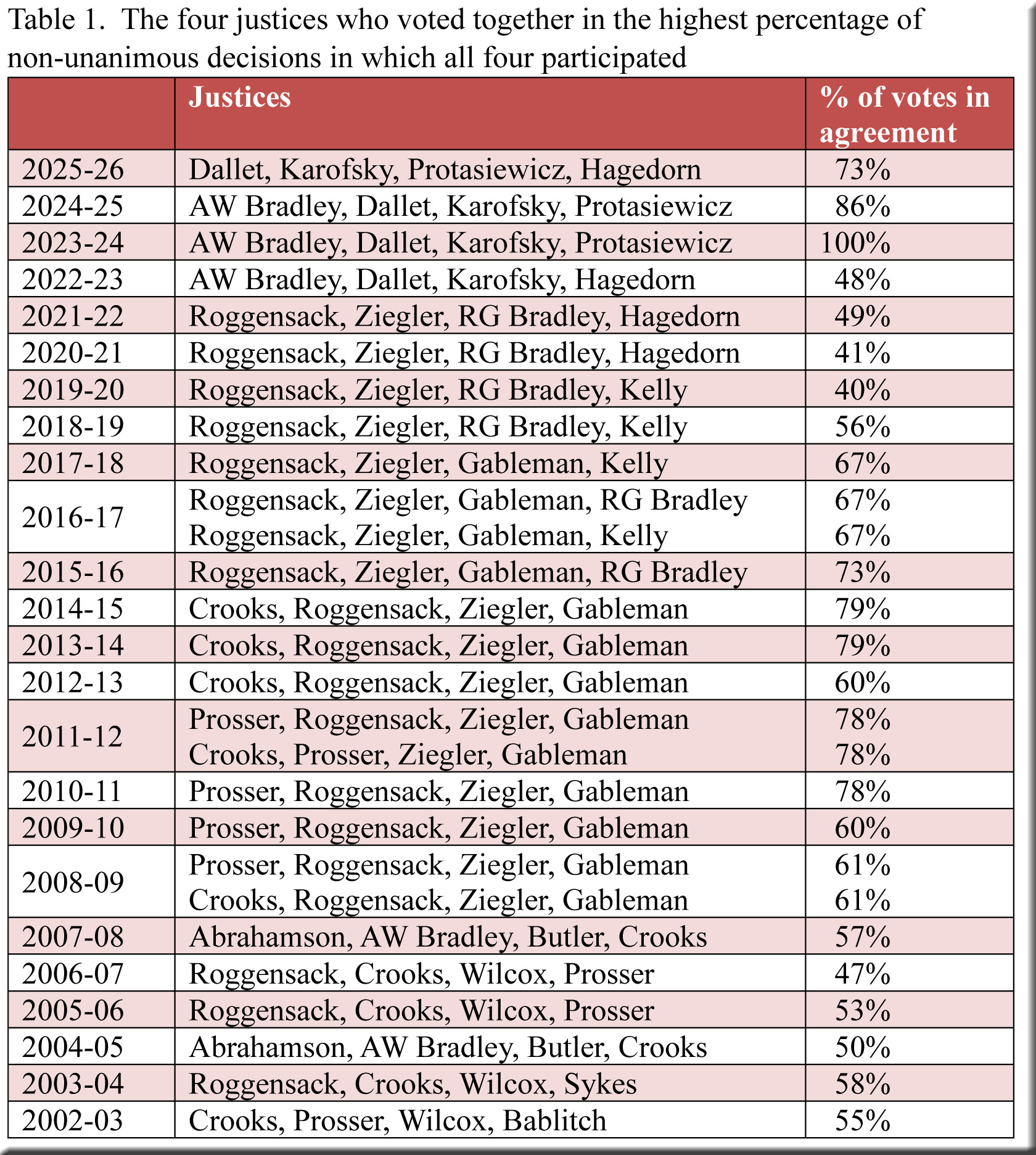
In 2023-24 the four liberals (Justices AW Bradley, Dallet, Karofsky, and Protasiewicz) voted in agreement (and thus in the majority) in every decision and, the following term, in all but two decisions. This degree of bloc cohesion was extraordinary, and it seemed likely to persist in 2025-26 when the “liberal Susan Crawford,” as newspapers described her, replaced Justice AW Bradley.
It did not. Table 1 shows which four justices voted in agreement most often in non-unanimous decisions each term, and there, for 2025-26, we find Justice Hagedorn, and not Justice Crawford, alongside Justices Dallet, Karofsky, and Protasiewicz. Justice Crawford did vote with the latter three in 64% of these cases, but this was well below the liberals’ level of bloc cohesion during the two preceding terms, and it could not match the extent of accord (73%) achieved after substituting Justice Hagedorn for Justice Crawford in the computation.
To be sure, none of Justice Crawford’s three dissents occurred in high-profile politicized cases, where she has given no indication of parting with Justices Dallet, Karofsky, and Protasiewicz. She wrote the decision in Legend Lake Property Owners Association, Inc. v. Guy Keshena (regarding the scope of tribal sovereign immunity) and joined the majority in Wisconsin State Legislature v. Josh Kaul (ruling against the Republican-controlled legislature), with Justice Hagedorn dissenting in both. But it will be interesting to see if, in other sorts of cases, Justice Hagedorn remains slightly more in step than Justice Crawford with Justices Dallet, Karofsky, and Protasiewicz as the 2026-27 term unfolds.
On this point, though it’s too early for certainty, observers may wonder if Justice Crawford will come to seem more liberal than some of the other “liberals,” at least on particular issues. A recent post suggested this possibility in criminal cases, which helps explain her “replacement” by Justice Hagedorn in Table 1.
Justice Hagedorn
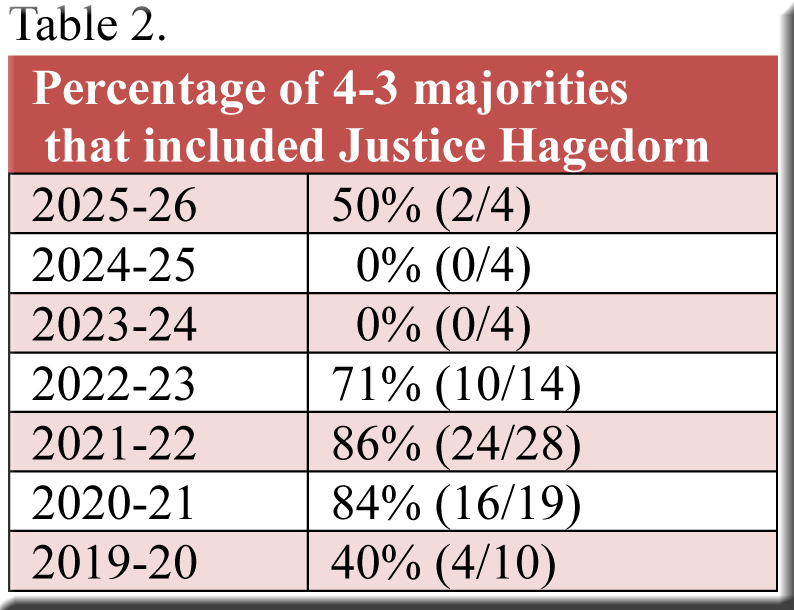
Over the past seven terms, no other justice’s influence has soared, plummeted, and risen again as dramatically as Justice Hagedorn’s (Table 2). From 2020-21 through 2022-23, when the court found itself divided between three liberals and three conservatives, he ascended as the crucial fourth vote that each side needed to prevail in contentious cases. Consequently, he appeared in far more 4-3 majorities than any other justice during this period.
However, the arrival of Justice Protasiewicz in 2023-24 furnished the liberals with a fourth vote of their own, eliminating the need to court Justice Hagedorn. He vanished entirely from 4-3 majorities for two years, and as the 2025-26 term dawned, there was little reason to suppose that he would play a significant role in these decisions. By term’s end, though, he had emerged once more as a participant of consequence—if not at the apex of his prior clout, nevertheless a conspicuous voice in some cases. While still dominant, then, the liberals were no longer the only votes in 4-3 majorities, as they had been throughout the two preceding terms.
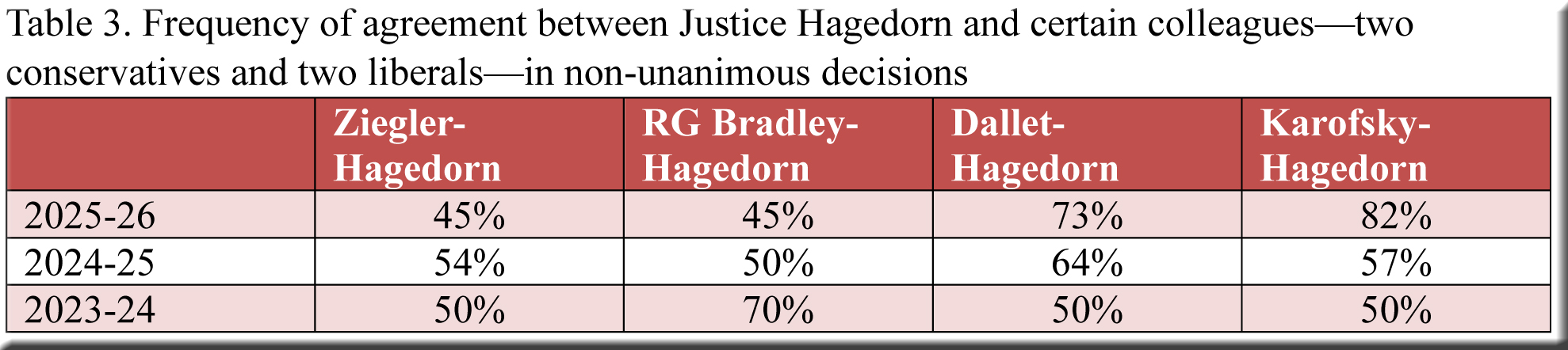
Justice Hagedorn’s revival also catches the eye when we consider all non-unanimous decisions, not just those decided by a single vote. After appearing in only half of these majorities in 2023-24, his share rose to 64% the following year and climbed all the way to 82% in 2025-26—not far below Justices Dallet and Protasiewicz (each at 91%) and higher than Justice Crawford at 73%.[1] In contrast, the court’s most resolute conservatives, Justices Ziegler and RG Bradley, joined only 27% of non-unanimous majorities last term.
In a nutshell, over these three terms Justice Hagedorn has voted ever more frequently with the liberals, and ever less so with the conservatives. Table 3 illustrates this by displaying the percentage of cases in which pairs of justices took the same side—either both in the majority or both dissenting—in non-unanimous decisions.
2026-27
The upcoming term will be the first with five justices identified as liberals, which raises questions pertaining to today’s topic. For instance, back when the court had five conservative members, the two liberals (Justices Abrahamson and AW Bradley) were marginalized. Will something comparable occur with both Justices Ziegler and Hagedorn, or will Justice Hagedorn continue his recent trajectory of blending with the liberals, leaving Justice Ziegler completely isolated, following the retirement of Justice RG Bradley?
Also, will bloc cohesion dissipate further among the liberals, now five in number? With only four necessary to prevail, a fifth who harbored misgivings might feel no pressure to stay in line to preserve a majority. And, if so, which of the five will break ranks most often and go her own way?
[1] Justice Karofsky participated in every one of the non-unanimous majorities.
 About Alan Ball






Speak Your Mind