Posts on the use of AI to evaluate briefs[1] have prompted questions regarding AI’s potential to process petitions for review. I suspect that much of the interest here stems from the unusually small number of cases decided in recent years and the resulting question of why this might be. Hypotheses have varied, but they tend to include conjectures that: (1) the court commissioners who appraise petitions are recommending far fewer cases for review, or (2) the justices are rejecting most of the grant recommendations that they receive from the commissioners. Perhaps some of both. Against this background, let’s see how AI performs when asked to help identify which petitions present issues that merit the justices’ attention.[Continue Reading…]
The 2025-26 Fantasy League Medalists
This season featured the dramatic revival of the Gavels of the State Public Defender’s Office. After spending the previous season mired in last place, they led from wire to wire in 2025-26 and cruised to a comfortable victory, as shown in the table below. Seven members of the Gavels delivered oral arguments—led by Timothy Drewa (10 points) and Colleen Marion (7 points)—a remarkable total given the small number of cases heard. Normally, the Department of Justice conducts far more oral arguments than any other firm or agency (and thus does not participate in the Fantasy League). This season, for the first time ever, the Gavels matched the DOJ’s total.
At its awards banquet earlier this week, the league honored not only the Gavels but also the leading scorers from each team: Crivello, Nichols & Hall powered the Waivers with 10 points, the same total posted by the Wisconsin Institute for Law and Liberty for the Writs. Meissner Tierney led the Affirmed with three points.
The following table provides totals for every individual law firm.
Wisconsin Supreme Court Statistics, 2025-26
These tables are derived from information contained in 19 Wisconsin Supreme Court decisions filed between September 1, 2025, and the end of the court’s term in the summer of 2026. The total of 19 decisions omits orders pertaining to various motions, … [Continue reading]
The 2025-26 Term: Some More Impressions

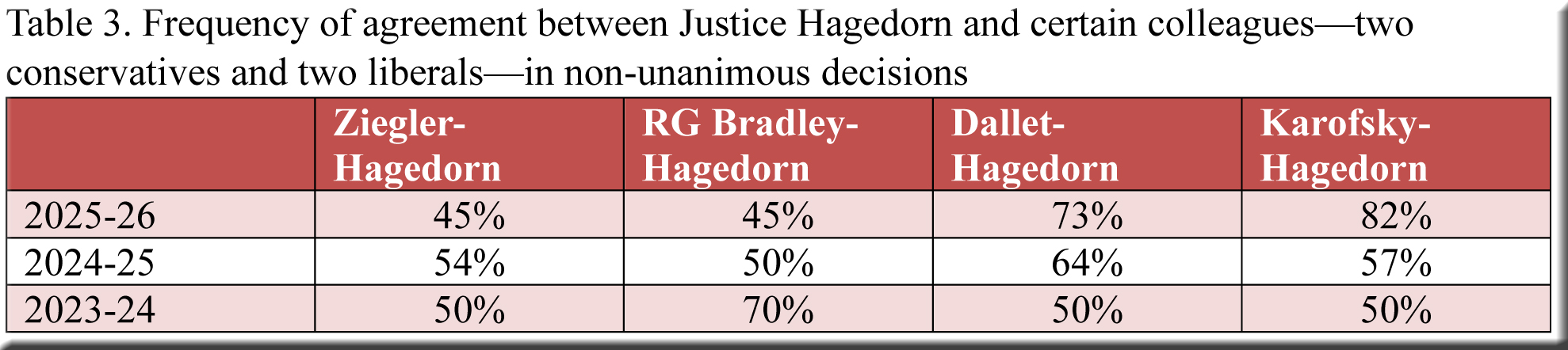
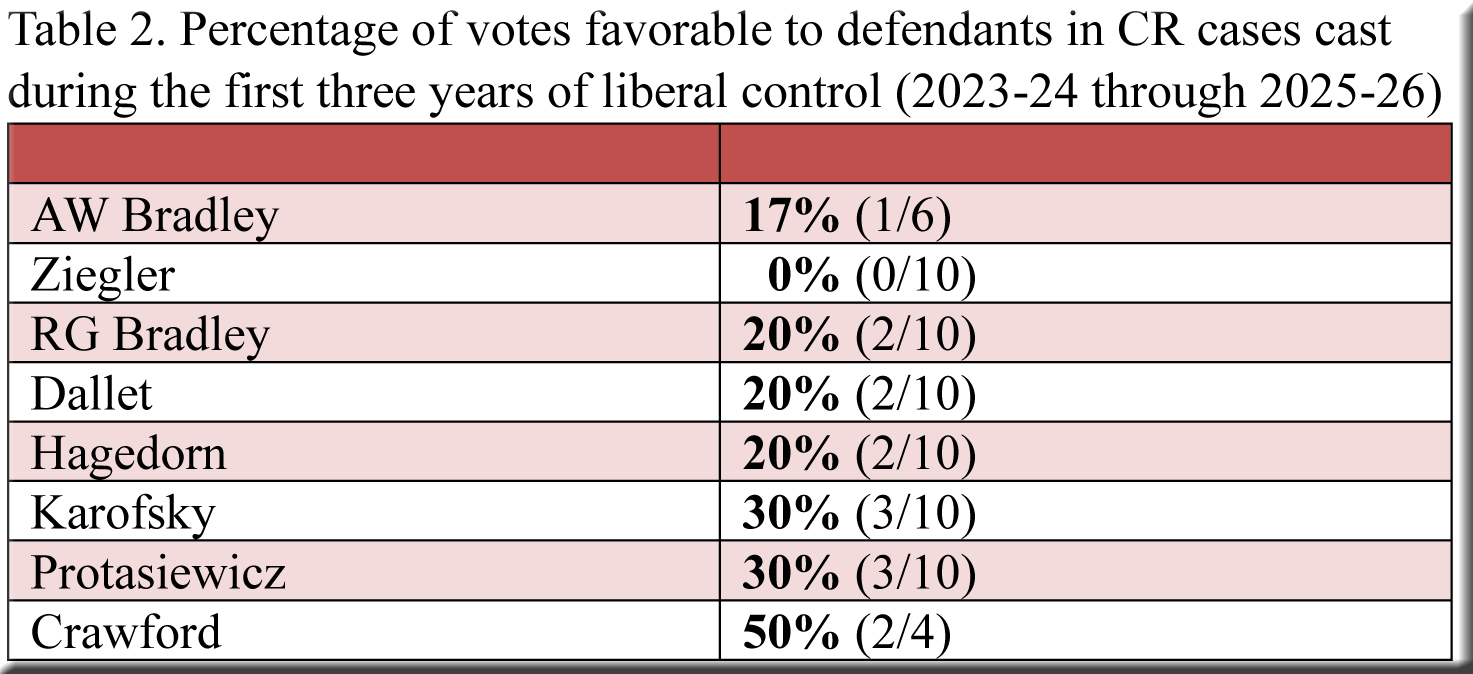
When Janet Protasiewicz joined the bench for the 2023-24 term, the court entered an unparalleled period of liberal control that produced voting patterns conspicuously different from those of previous years. Some of this continued in 2025-26—but with … [Continue reading]
The Supreme Court’s 2025-26 Term: Some Initial Impressions

With the filing of the term’s last substantive decision, it’s time for the first installment in our annual survey of the justices’ work. Recent years have generated some unusual developments, and it will be interesting to see if they persisted in … [Continue reading]
How Liberal is the Supreme Court?

In many respects, the label fits. Ever since the arrival of Janet Protasiewicz in the 2023-24 term, justices regarded as liberals have dominated the court. They formed the majority in nearly all non-unanimous cases for three years running,[1] and … [Continue reading]
Law Firm Fantasy League
Three teams gained points from this week’s flurry of decisions, led by the Waivers who vaulted up the standings with 10 points from Crivello, Nichols & Hall (for a brief, oral argument, and favorable outcome in Wisconsin Voter Alliance v. … [Continue reading]
Law Firm Fantasy League
The Gavels of the State Public Defender’s Office collected five points for their brief and oral argument in Waukesha County v. R. D. T., keeping them atop the standings. … [Continue reading]
Law Firm Fantasy League
Two of this week’s decisions boosted the Gavels of the State Public Defender’s Office, strengthening their position atop the standings. They collected 11 points for a brief, oral argument, and favorable outcome, along with an amicus brief, in State … [Continue reading]
Wisconsin Supreme Court Statistics, 1915-16
These tables are derived from information contained in 287 Wisconsin Supreme Court decisions that were turned up in a Nexis Uni search for decisions filed between September 1, 1915, and August 31, 1916. The total of 287 decisions does not include … [Continue reading]