Posts on the use of AI to evaluate briefs[1] have prompted questions regarding AI’s potential to process petitions for review. I suspect that much of the interest here stems from the unusually small number of cases decided in recent years and the resulting question of why this might be. Hypotheses have varied, but they tend to include conjectures that: (1) the court commissioners who appraise petitions are recommending far fewer cases for review, or (2) the justices are rejecting most of the grant recommendations that they receive from the commissioners. Perhaps some of both. Against this background, let’s see how AI performs when asked to help identify which petitions present issues that merit the justices’ attention.
The method
At the end of July, the court’s website recorded over 300 cases that were awaiting decisions on petitions for review. From this collection I first removed cases with handwritten petitions and those labeled “confidential” (whose petitions are not provided), yielding a set of 342 cases. Given that I wanted AI to analyze not only the petitions but also the responses to these petitions, I trimmed an additional 118 cases that lacked responses (in late July) and also Nicola Charlton v. Mark Charlton, which involved eight documents (a petition and seven responses), more than Claude could handle.
I then asked Google’s Gemini and Anthropic’s Claude to scrutinize the petitions and responses for each of the remaining 223 cases and decide whether the court should grant review. If both Gemini and Claude agreed that a petition passed muster on at least one issue, the case entered the following list of 55 warranting the supreme court’s deliberation—an acceptance rate of 25% (55/223).
The result
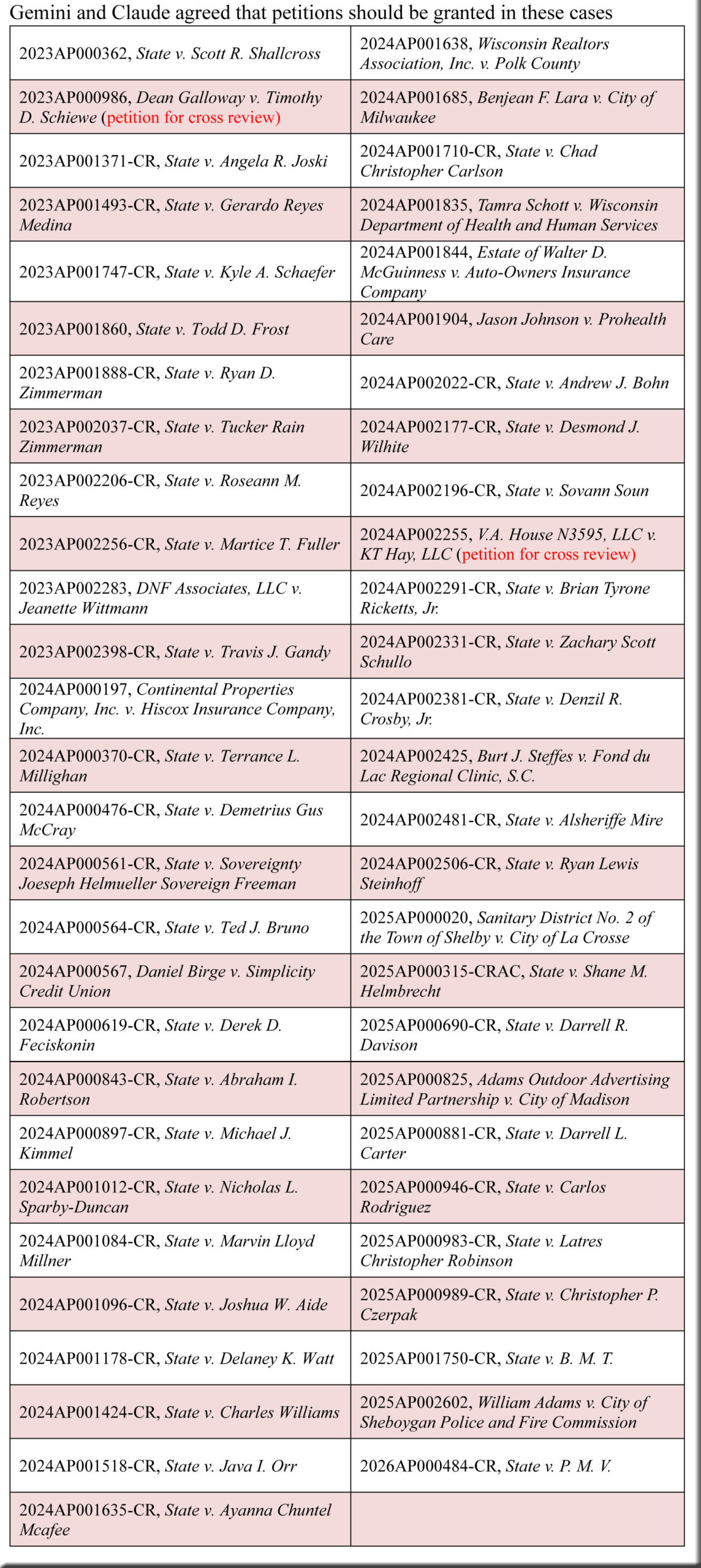
These cases are not the only ones that Gemini and Claude would submit to the justices. New petitions continue to be filed, and the justices often[2] take “confidential” cases outside our field of vision, as are the 118 cases without responses. The table simply furnishes an opportunity to ascertain how frequently the commissioners and justices agree with Gemini and Claude over the next few months regarding the 55 cases before us.
After their petitions conference in August, the justices granted petitions in six cases from the table but denied 22, as detailed in the attached chart. Rulings for the table’s remaining 27 cases have been deferred to future petitions conferences. While we wait, I tested our two AI assistants on 11 cases decided back during the 2025-26 term—that is, cases for which review had already been granted.[3] After examining the petitions and responses in each of these, Gemini and Claude agreed that all of them deserved acceptance. In a nutshell, then, it appears that nearly every petition deemed worthy by the court also satisfies Gemini and Claude, but these two AI assistants cast a wider net than do the commissioners and justices.[4]
Readers curious (or skeptical) about the level of AI’s proficiency in appraising petitions should consult the following footnote to find the full analysis generated by Claude and Gemini for a sample of three cases from the table.[5] I would be grateful for reactions that anyone may wish to share.
Personality
Both Gemini and Claude seemed well informed and judicious, but Claude cultivated a cheekier tone on occasion. While neither shied away from criticizing petitions and responses, Claude’s rebukes more often approached humor. They could even reach sarcasm, especially when encountering the State’s common practice of filing a perfunctory response that failed to address any of the issues raised in a petition:
(State v. Sam M. Shareef, 2025AP000661-CR)
The [State’s] one-paragraph letter is a missed opportunity, though probably a defensible bet. It says nothing about Quelle, nothing about the warrant, nothing about the truth of the officer’s statement, and nothing about the mismatch between the alleged violation and the remedy sought — all arguments that would have made denial obvious rather than merely likely. If a justice reads only these two documents, the petitioner’s framing is the only framing on offer. That’s a real risk the State accepted for no apparent gain beyond saving an afternoon.
Conclusion
Gemini and Claude have made remarkable progress with analytical duties such as those performed for this post. Not only are they blazingly fast, but the depth of their research also far exceeds their limits of just a year or two ago. Moreover, some may argue that AI is less skewed by preconceptions nudging human readers to anticipate, if only subconsciously, that a particular petition will possess, or lack, merit. In other words, as Gemini and Claude begin their assessment, they are undoubtedly less swayed by whether the author is an assistant attorney general, a sole practitioner, a partner at a major firm in Milwaukee, a pro se litigant, or a lawyer from a firm known for its liberal or conservative stance. With these advantages, a chatbot crafted specifically to evaluate petitions might well be a useful assistant to court commissioners and justices.
That said, the possibility of AI hallucination persists, even though, we are told, the frequency is declining. Gemini and Claude (or a custom designed chatbot) may already do a credible job processing petitions, but it’s hard to imagine that anyone feels it safe to entrust this task to them without oversight.
The issue of bias remains as well, albeit not in a form familiar to us. As noted above, Gemini and Claude did not always agree on petitions, which raises the question of could this disparity be interpreted as an indication of bias. And, if so, bias on whose part? Although beyond the scope of this study, I do wonder if Gemini or Claude could be revealed as more sympathetic to petitions of one type or another—or whether their differences of opinion seem entirely random. Whatever the reason for their periodic disagreement, it must have something to do with how the models train themselves—and perhaps the decisions made by human architects of this training. If a pattern were to emerge showing that Claude or Gemini smiled more kindly on a certain category of petition, it would indeed be a provocative topic.
[1] An AI Justice at the Wisconsin Supreme Court: 2015-16 and 2023-24 and Do Amicus Briefs Matter to an AI Justice?
[2] For instance, of the 19 decisions filed in 2025-26, five were “confidential.”
[3] The total of 11 cases does not include five “confidential” cases and three certified by the court of appeals.
[4] The court did accept one case that failed to make the cut for our table: Appvion, Inc. Retirement Savings and Employee Stock Ownership Plan v. PricewaterhouseCoopers LLP. Here is Claude’s rationale for denying the petition.
[5] These links provide the analysis from Gemini and Claude for a trio of the table’s cases. In State v. Travis J. Gandy they concurred that the petition should be accepted. They both rejected the petition in State v. Zachary Paul Nush. In Sauk Prairie Conservation Alliance v. Wisconsin Department of Natural Resources, they disagreed.
 About Alan Ball






Speak Your Mind