In many respects, the label fits. Ever since the arrival of Janet Protasiewicz in the 2023-24 term, justices regarded as liberals have dominated the court. They formed the majority in nearly all non-unanimous cases for three years running,[1] and many of their rulings would have been inconceivable in the era of conservative sway not long ago. Such decisions as those on abortion, voting procedures, election maps, tribal rights, and medical negligence—all filed over conservative dissents—bolstered a claim that the court’s liberal inclinations are more pronounced now than twenty years ago during the tenure of Justice Louis Butler. Although that conclusion is not wrong,[2] today’s post addresses one area where it does not apply.
Criminal cases
These cases[3] are appeals filed either by defendants contesting some aspect of their conviction, or by the state disputing a court of appeals ruling that favored a defendant. During Justice Butler’s four years—2004-05 through 2007-08, when liberals were influential but not in control—the court ruled for defendants in 28% of criminal cases. One might suppose that, with the onset of full-blown liberal supremacy twenty years later, the percentage would more likely rise than fall. But fall it did, down to only 20% of such cases.
Nor should the Butler years be deemed exceptionally indulgent toward defendants. During the nine years prior to his arrival—1995-96 through 2003-04—the court found for defendants in 31% of criminal cases. Viewed in this light, the 20% figure for the current court is more surprisingly low than the 28% for the Butler years is surprisingly high.
Head to head
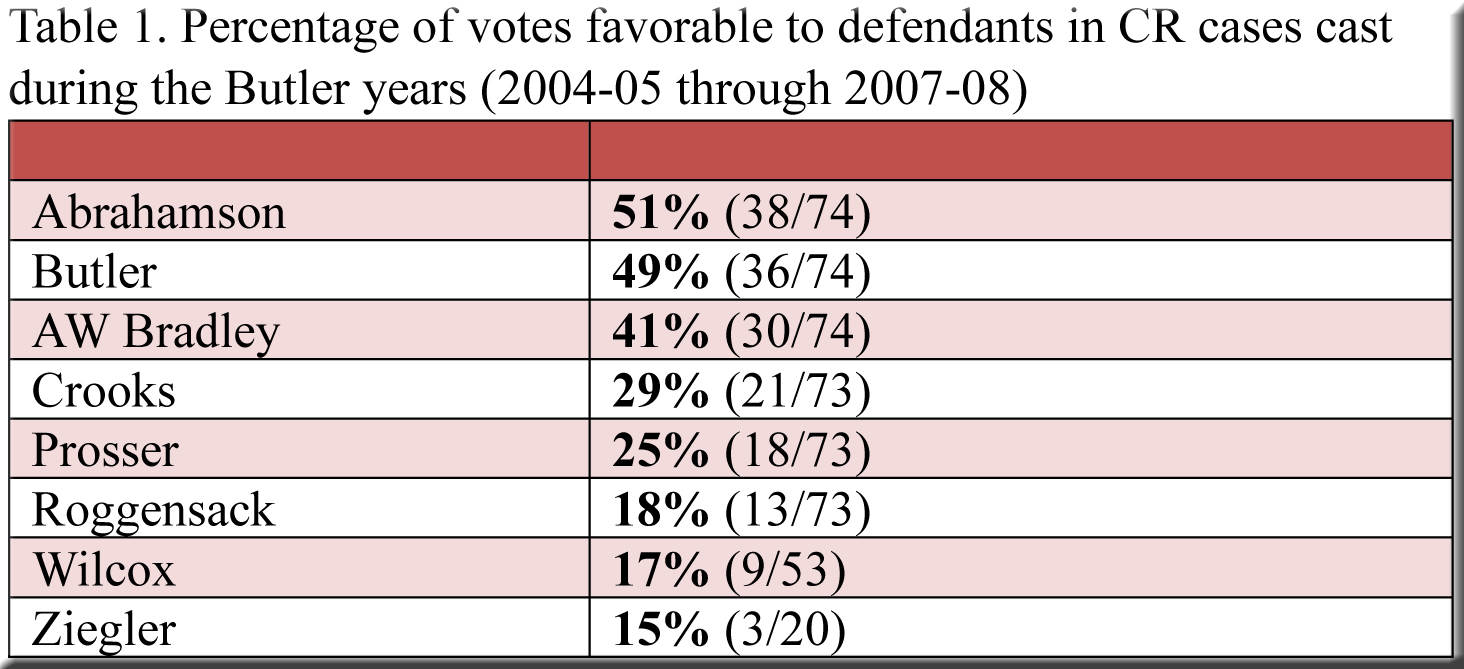
This disparity between the Butler years and the current court becomes more vivid when we inspect the voting records of individual justices in criminal cases. During the Butler period the gap between the three liberals (Justices Abrahamson, Butler, and AW Bradley) and the three staunchest conservatives (Justices Roggensack, Wilcox, and Ziegler)[4] was substantial—a difference of roughly 25-30 percentage points, as detailed in Table 1.
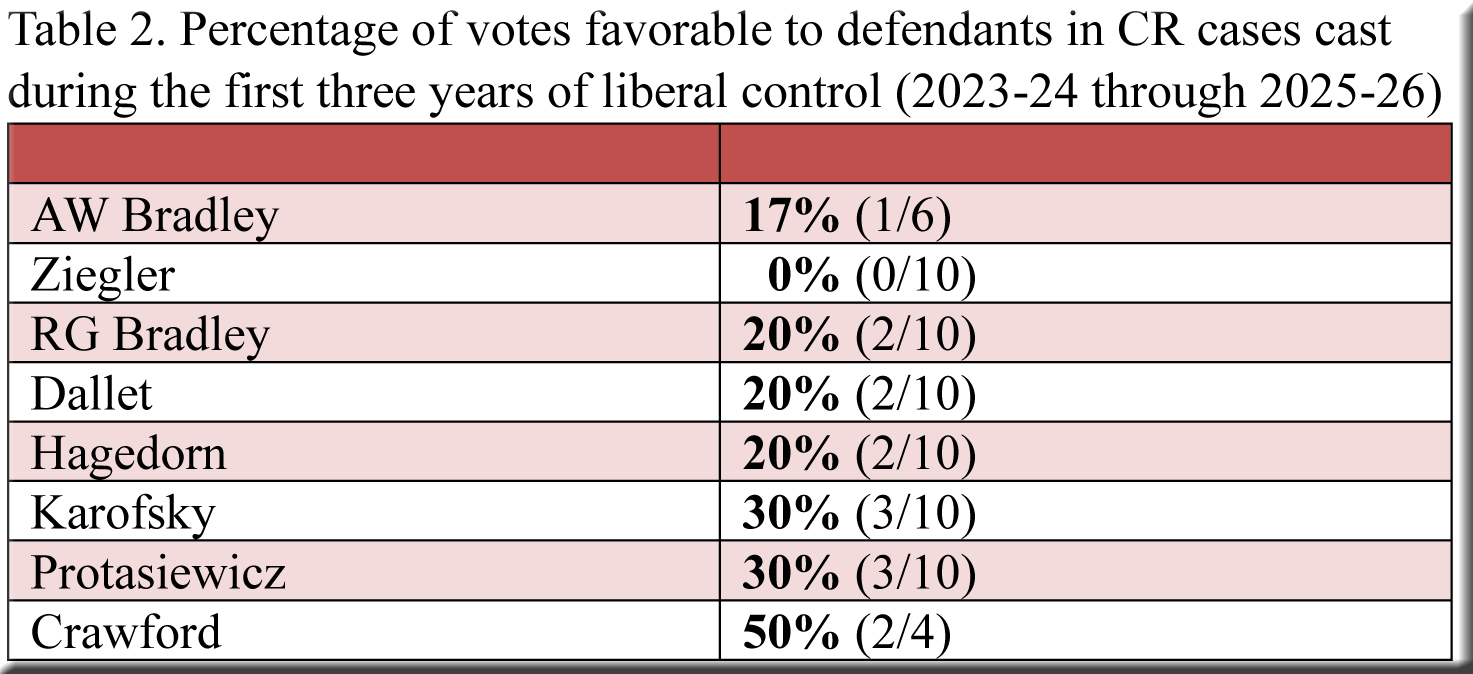
Compare this with the period of the current court’s liberal hegemony, displayed in Table 2. Excluding Justice Crawford, whose single term of service encountered only four relevant cases,[5] the percentages for the other liberals are (a) much lower than the liberals’ percentages in Table 1 and (b) much closer to the percentages of two conservatives (Justices RG Bradley and Hagedorn).
Why?
How could the supreme court during the Butler years (and well before)—when liberals did not dominate decisions—have listened more receptively to defendants’ arguments than does a court with liberals firmly ascendant? Although explanations must remain speculative, certain factors may bear consideration.
One pertains to the way in which the Butler years ended. When challenger Michael Gableman defeated Justice Butler in the spring of 2008, he did so with a campaign that employed controversial television ads characterizing Butler as soft on crime. By the standards of the time, the ads seemed brazenly aggressive,[6] provoking much comment from observers and an ethics-violation charge from the Wisconsin Judicial Commission.[7]
More to the point here, the ads were thought to have contributed to Gablemen’s victory, as demonstrated by the fact that they came to serve as precedent or inspiration for menacing “soft on crime” ads in subsequent supreme court elections. Indeed, a Wisconsin Watch article on the 2025 race between Susan Crawford and Brad Schimel opened with examples of ferocious ads—accusing Schimel of letting “a sex predator loose on our kids” and Crawford of “putting pedophiles back on the street”—and traced this approach to the 2008 Butler-Gableman race.[8] Nationally, too, numerous studies have documented the proliferation of television ads in judicial races that portray opponents as lenient toward criminals.[9] Clearly, the assumption among campaign managers and other advisers is that these ads work, whether or not their impact can be calculated precisely.
In such an environment, those seeking a seat on the Wisconsin Supreme Court will be urged to accentuate how severe they are on crime, and nothing suits this purpose more effectively than pointing to one’s previous exertions as a prosecutor.[10] It has become the electoral equivalent of a vaccine against soft-on-crime accusations. Candidates without prosecutorial inoculations, and especially if their careers have included employment as criminal defense attorneys, can expect an onslaught akin to that directed at Justice Butler (a former public defender) in 2008.
This leads us to wonder whether something more than coincidence finds all four liberals now on the court (and all elected after 2008) to have held positions representing the government against defendants. An abbreviated sample lists the Milwaukee County District Attorney’s Office (Justices Dallet and Protasiewciz), the Dane County District Attorney’s Office (Justice Karofsky), and the Wisconsin Attorney General’s Office (Justices Karofsky and Crawford). In contrast, none of their liberal predecessors from the Butler period reached the court with prosecutorial backgrounds.
Returning, then, to the disparity between Tables 1 and 2, perhaps the current liberals’ relative disinclination to favor defendants’ arguments stems in part from their understandable familiarity and sympathy with assertions that they once delivered themselves as prosecutors—together with their comparative remoteness from the experiences and vantage point of the defense bar. And, of course, the same could hold in reverse among the three liberals during the Butler years. For those desiring balance between the two perspectives, the electoral arena described above has not been auspicious. In other words, criminal-defense backgrounds likely complicate prospective candidates’ decisions to run, while prosecutorial vocations seem an asset.[11]
That said, the court has acquired a new justice for the 2026-27 term who does not fit the recent mold, for Chris Taylor is a liberal without a prosecutorial past. This, along with an election campaign that lacked an abundance of vehement tough-on-crime vows raises the question of whether her voting record in criminal cases will differ markedly from those of other liberals.
In this regard, it may also be interesting to follow Justice Crawford. As noted, her first year on the court provided only four opportunities to vote in criminal cases, but this tiny sample includes an intriguing item—a dissent in State v. J. D. B. Her liberal colleagues joined the conservatives in rejecting a defendant’s argument pertaining to an involuntary medication order, but Justice Crawford did not. The substance and to some extent the tone of her dissent recalled liberal opinions from an earlier era, prompting speculation that she might develop a voice in criminal cases distinct from those of justices with whom she shared prior careers as prosectors.
[1] On very rare occasions, one of the liberals dissented, and the other three were joined by at least one conservative. Only once over the entire three years did two liberals dissent (Justices Dallet and Protasiewicz in Racine County v. R. P. L.).
[2] Previous posts have demonstrated that liberals now dominate the court to a much greater extent than during the Butler years (2004-05 through 2007-08). See for example “A Liberal High-Water Mark?” and “Three Realignments: Voting Coalitions from 2016 to 2025.”
[3] The study includes all cases whose numbers end with the CR (criminal) suffix, other than a small set of cases that yielded either per curiam rulings or decisions that did not clearly favor one party or the other.
[4] Justice Ziegler replaced Justice Wilcox for the 2007-08 term.
[5] She replaced Justice AW Bradley for the 2025-26 term.
[6] For examples, see Viveca Novak, “Winning Ugly in Wisconsin,” FactCheck.org, April 4, 2008.
[7] Final word regarding the ethics charge lay with the supreme court, which deadlocked 3-3 on the matter, effectively terminating it.
[8] Jack Kelly, “Vicious ads, record spending, Elon Musk: Wisconsin Supreme Court race reflects nasty, new normal,” Wisconsin Watch, March 19, 2025.
[9] For an example that includes a reference to the Butler-Gableman election, see Kate Berry, “How Judicial Elections Impact Criminal Cases,” The Brennan Center for Justice, 2015.
Of course, the “tough on crime” issue in judicial elections and judicial decisions has received attention in various places around the country prior to 2008. See for example Joanna Cohn Weiss, “Tough on Crime: How Campaigns for State Judiciary Violate Criminal Defendants’ Due Process Rights,” New York University Law Review, 2006; and Stephen B. Bright and Patrick J. Keenan, “Judges and the Politics of Death: Deciding Between the Bill of Rights and the Next Election in Capital Cases,” Boston University Law Review, 1995.
[10] In addition to positions in a district attorney’s office, this could include experience in the attorney general’s office representing the state in criminal appeals.
[11] As an analysis from the Brennan Center concluded, “[t]he fact that some TV ads highlight candidates’ experiences representing criminal defendants as evidence that they are ‘soft on crime’ demonstrates one obstacle for candidates from defender, as opposed to prosecutorial, backgrounds.” Berry, “How Judicial Elections Impact Criminal Cases.”
 About Alan Ball






Speak Your Mind