The passage of three years since the last update prompts our return to the question of how frequently women have been delivering oral arguments—as representatives of the Department of Justice, the Public Defender, private firms, and all categories combined. While the tiny number of decisions filed in recent years has yielded a correspondingly small volume of oral arguments, we can compensate by comparing data for three-term clusters to obtain reasonable sample sizes.
All categories
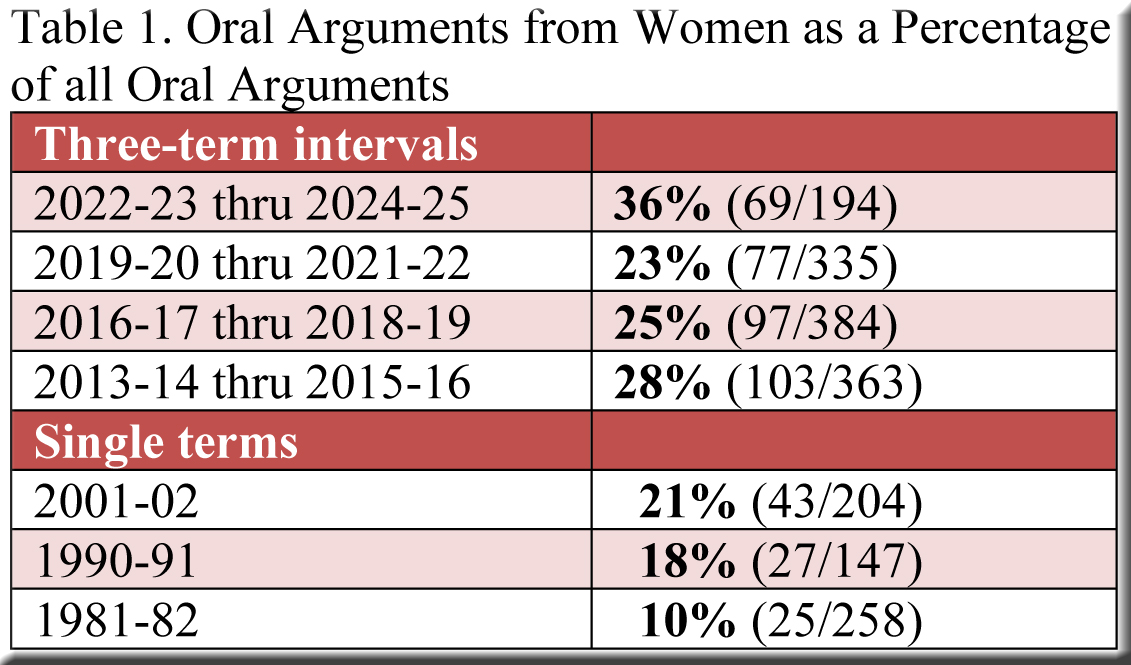
Let’s turn first to the broadest view—all agencies and firms taken together (Table 1). For several years, women were conducting approximately a quarter of oral arguments, but that portion swelled to 36% in the latest three-term cluster, with especially large contributions from 2022-23 (32%) and 2023-24 (54%). Even the figure of 29% for 2024-25 surpasses the average for previous terms.[1] It will be interesting to see if this becomes the norm—with women handling roughly a third of oral arguments—or whether the next post in this series finds that the average has dropped back to its earlier level.
Government agencies and non-profits compared to private firms
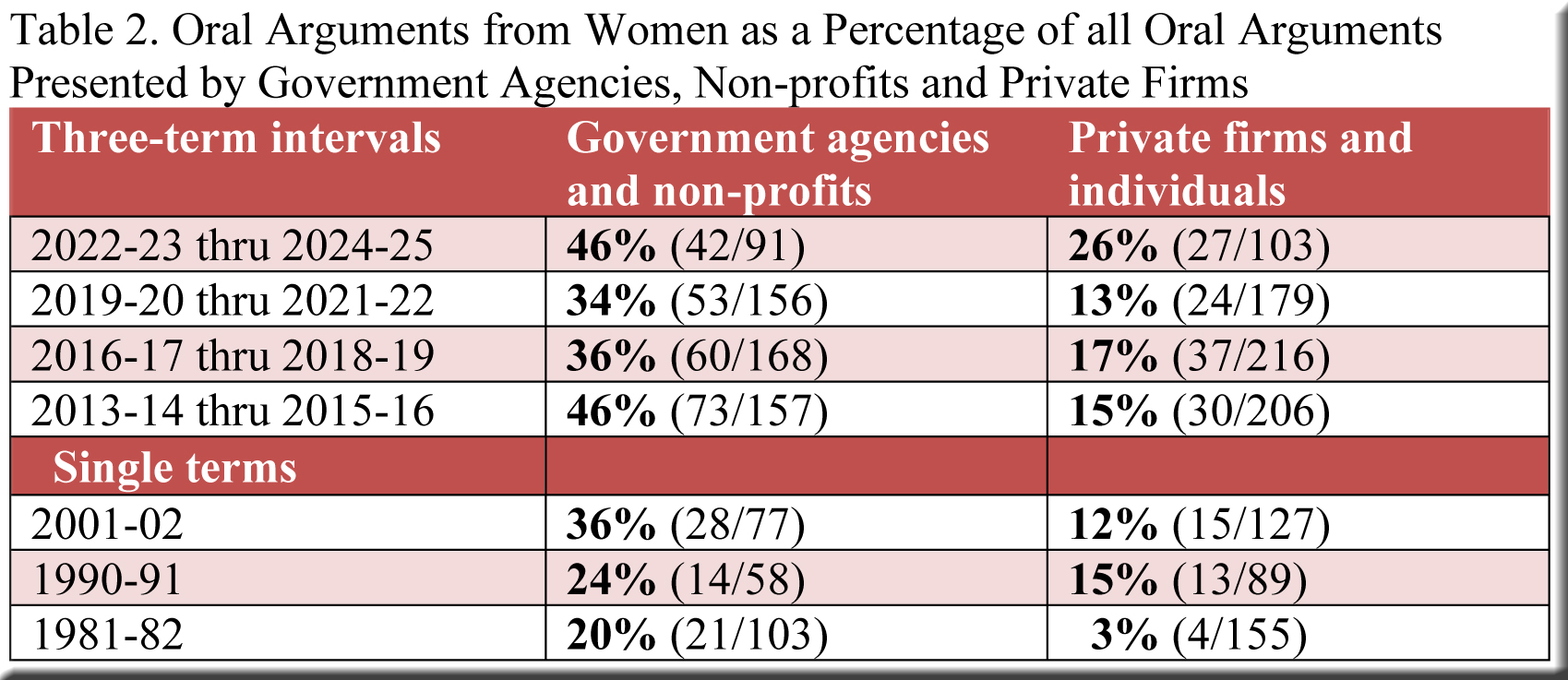
Perhaps the most noteworthy feature of Table 2 resides in the private-sector column, where women’s share of oral arguments soared to 26% in the most recent interval. This not only doubled their portion for 2019/20-2021/22, it far outstripped the percentage for all preceding periods. In the government/non-profit column, where women’s percentages have always exceeded those in the private-sector column, the 46% share in 2022/23-2024/25 did not mark an all-time high, as the 2013/14-2015/16 interval recorded the same figure.[2]
The Department of Justice and the Public Defender
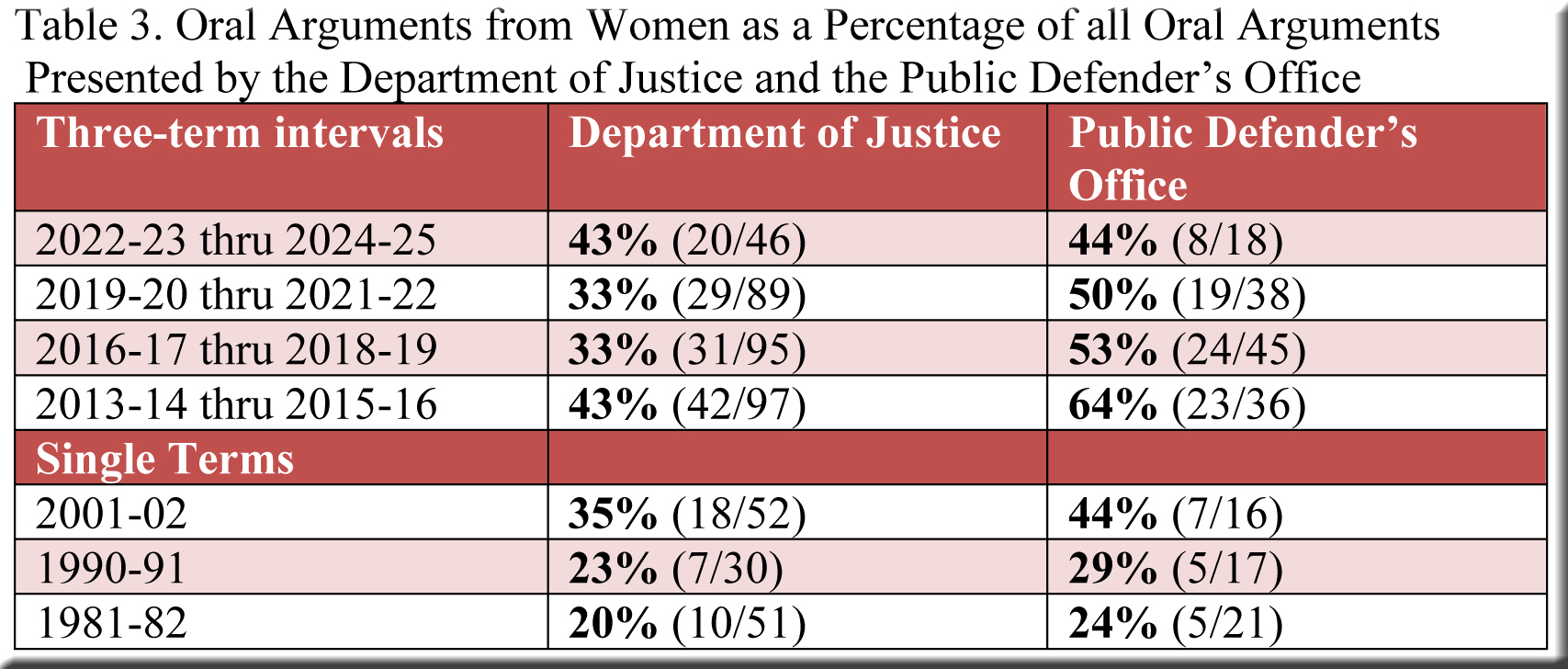
Given that attorneys from the Department of Justice (DOJ) deliver more than half the oral arguments in the government/non-profit category, it stands to reason that the women’s percentage of oral arguments from the DOJ mirrors the pattern displayed in Table 2 for the government/non-profit category as a whole—a substantial increase in 2022/23-2024/25 compared to the preceding interval (from 33% to 43%), but no higher than the portion for 2013/14-2015/16 (Table 3).[3]
In contrast to the DOJ (and especially the private sector in Table 2), women from the Public Defender’s Office saw their share of oral arguments diminish steadily through all four of the three-term intervals in Table 3. Although their percentage of 44% in 2022/23-2024/25 matched that of their counterparts at the DOJ (43%), it paled before their 64% portion in 2013/14-2015/16.[4]
[1] Click here for a table that provides data for every individual term.
[2] Click here for a table that provides data in these two categories for every individual term.
[3] Figures for the DOJ include the Solicitor General’s Office during the terms that its attorneys delivered oral arguments (2015-16 through 2018-19).
[4] Click here for a table that provides data in these two categories for every individual term.
 About Alan Ball






Speak Your Mind