During the past decade, the Wisconsin Supreme Court traversed three distinct eras created by changes in the court’s composition. The following tables and charts track these shifts and demonstrate how significantly they altered the influence of individual justices.
Conservative zenith (2016-17 through 2019-20)
When Michael Gableman defeated Louis Butler in 2008, conservatives began a long stretch of increasingly solid control of the court that prevailed all the way through the 2019-20 term. We’ll focus on the last four years of this period, when the court had not only four, but sometimes five, conservative members: Justices Roggensack, Ziegler, Gableman, Rebecca Bradley, and Kelly (2016-17 and 2017-18) and Justices Roggensack, Ziegler, Rebecca Bradley, and Kelly (2018-19 and 2019-20).[1] They were joined by at most three (2018-19), and usually only two, liberals: Justices Ann Walsh Bradley (2016-17 through 2019-20), Abrahamson (2016-17 through 2018-19), and Dallet (2018-19 and 2019-20).
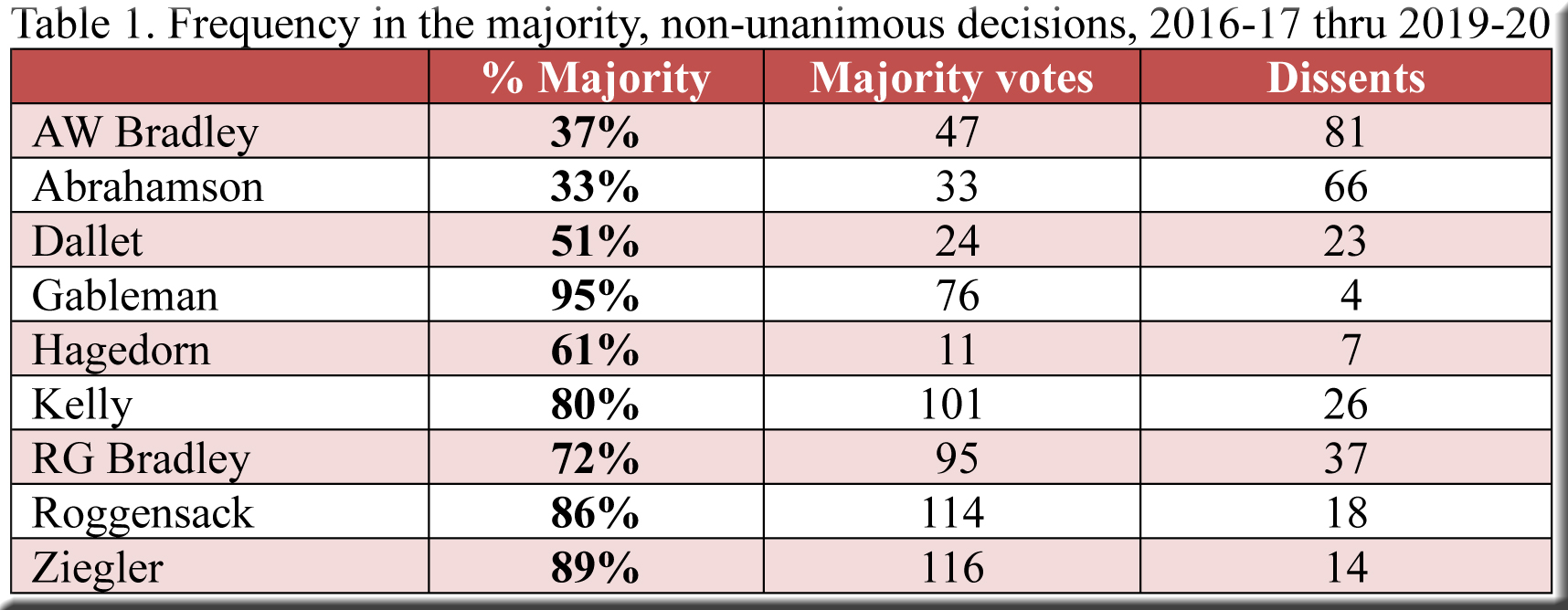
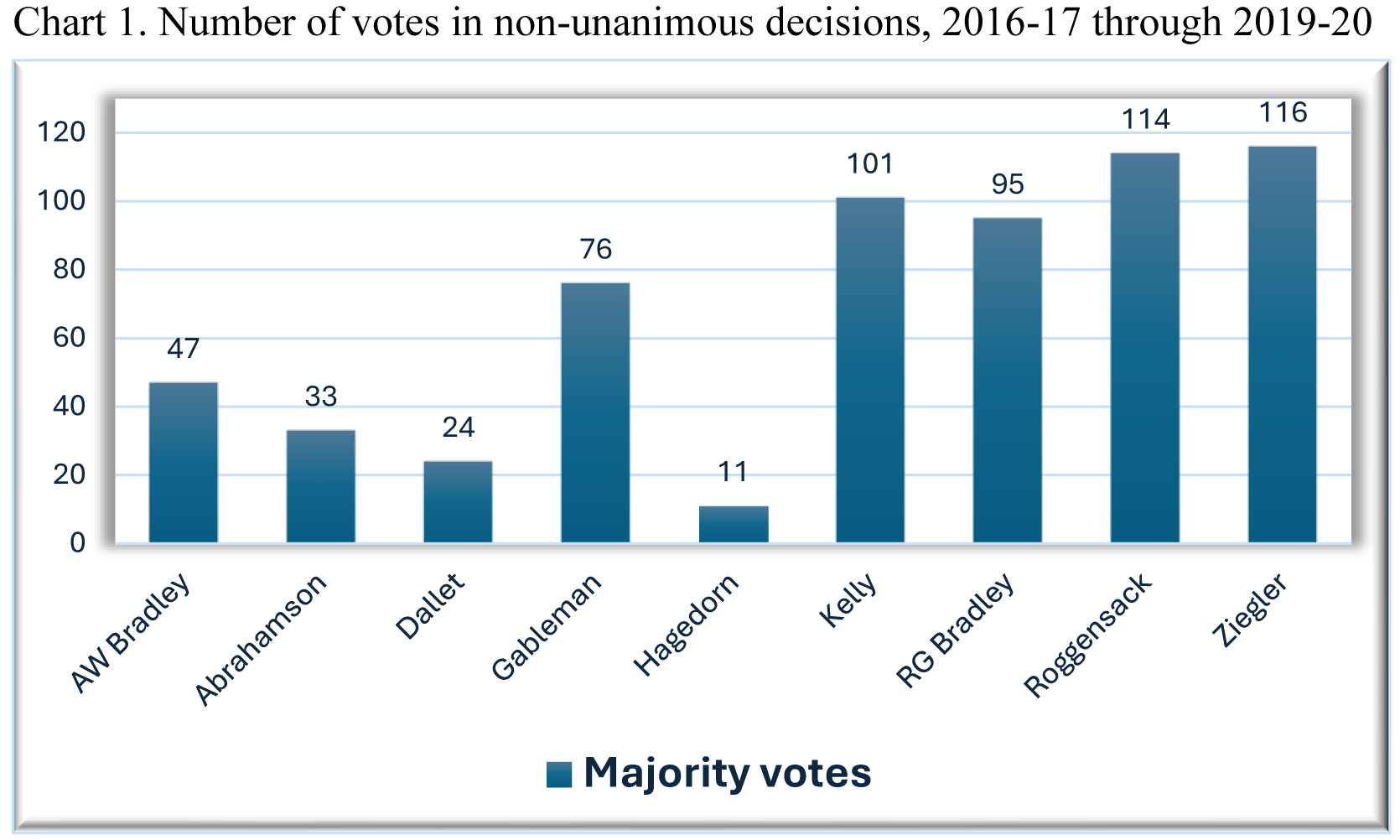
Conservative dominance catches the eye in diverse voting patterns, including the frequency with which justices cast majority votes in non-unanimous decisions (Table 1, Chart 1). Justice Gableman did so 95% of the time, followed by Justices Ziegler (89%), Roggensack (86%), Kelly (80%), and Rebecca Bradley (72%)—dwarfing the portions for liberal Justices Abrahamson (33%) and Ann Walsh Bradley (37%).[2]
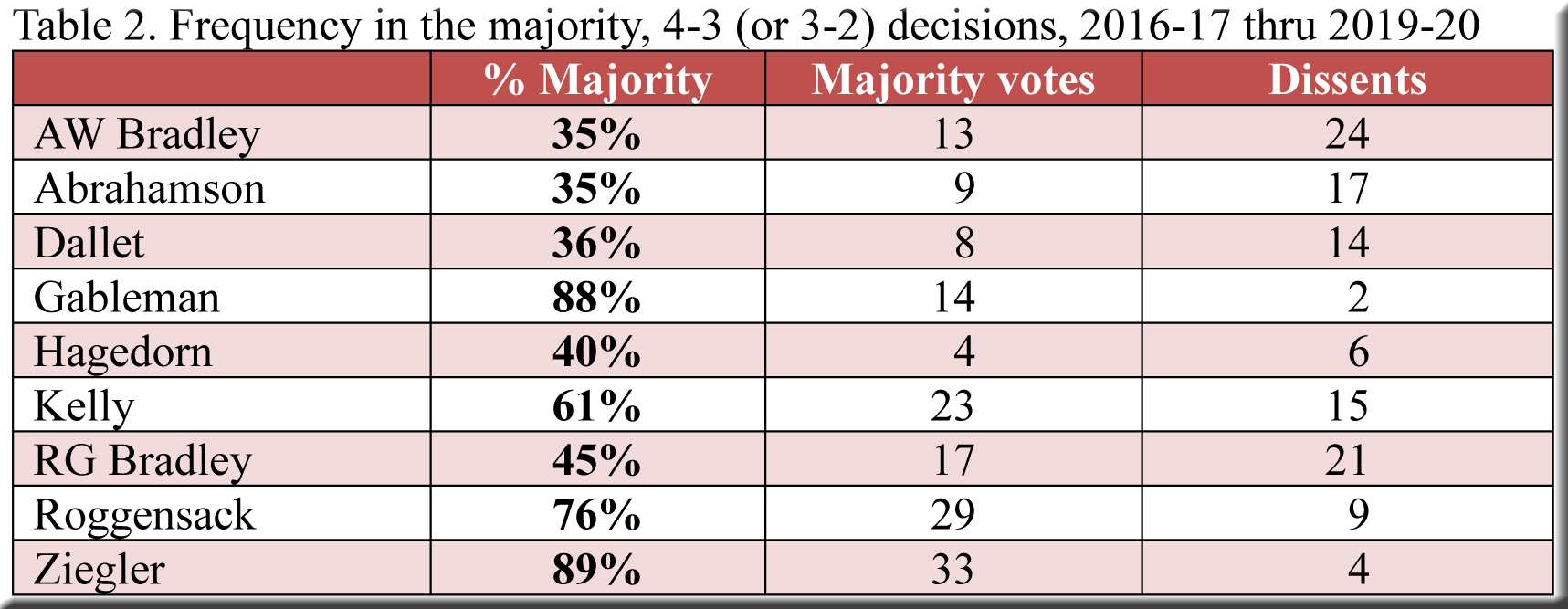
Conservatives generally marshaled four votes in even the most contentious cases, those decided by 4-3 (or, very rarely, 3-2) margins, as shown in Table 2. Their preponderance often allowed them to win without Justice Hagedorn, which would not be the case in the transition period to come.
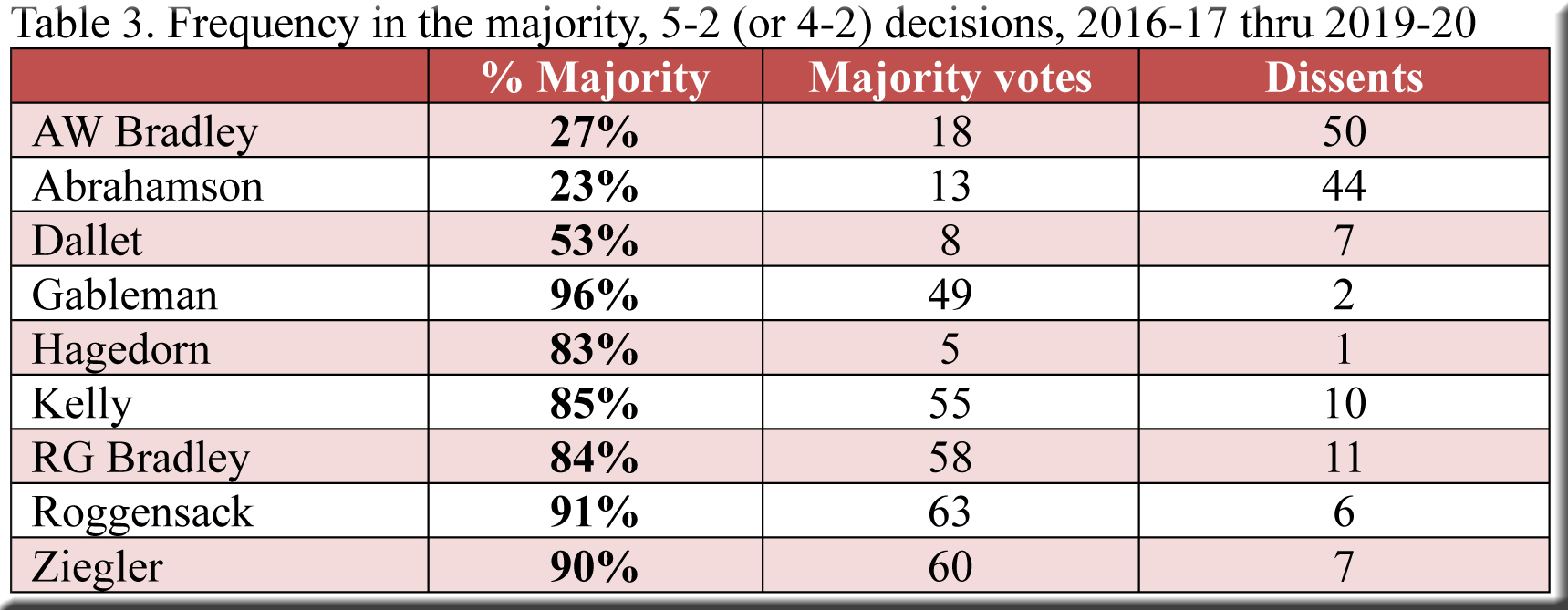
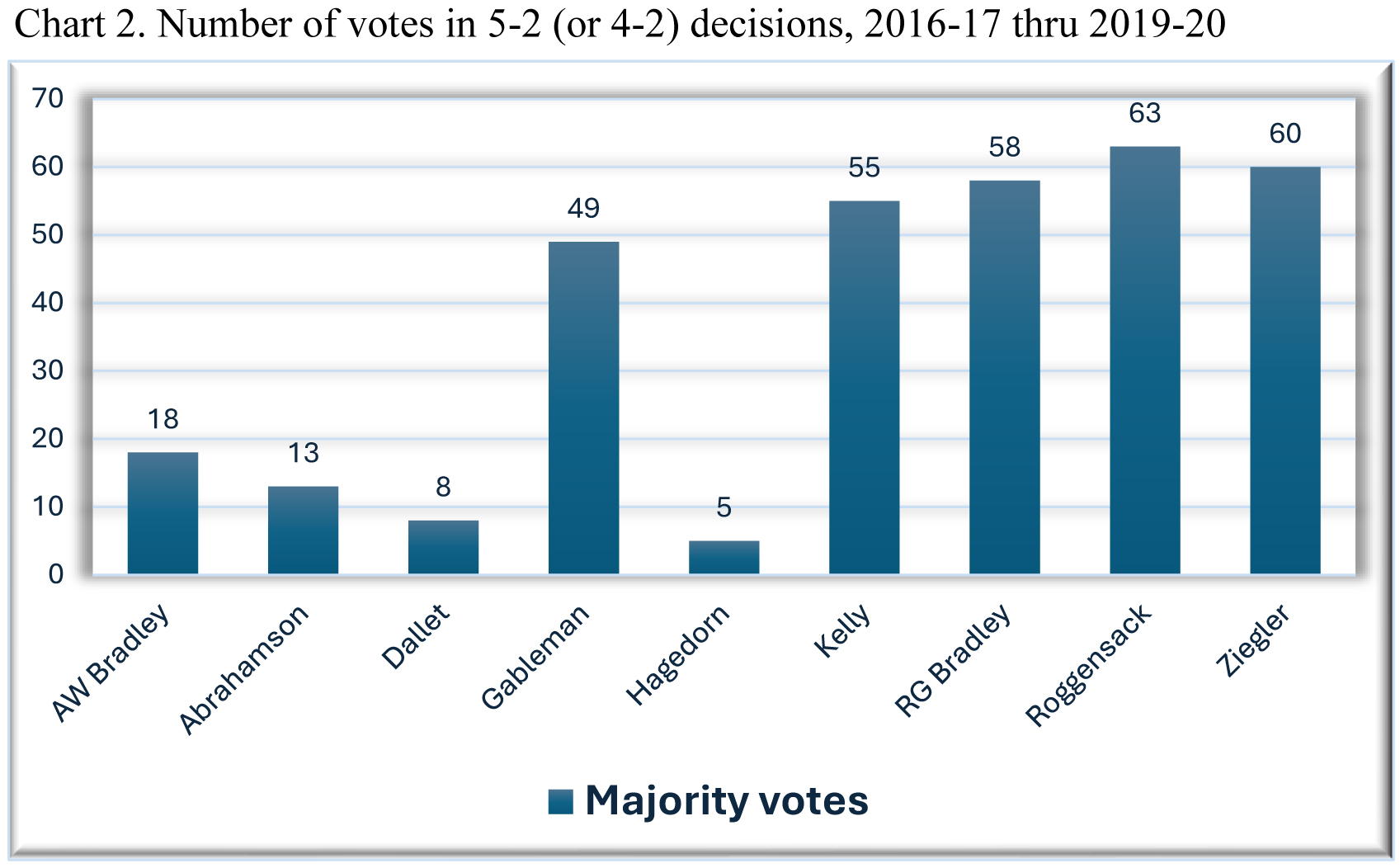
Meanwhile, liberal isolation in the minority persisted most vividly in decisions with only two dissenters—nearly always Justices Abrahamson and AW Bradley, as displayed numerically in Table 3 and visually in Chart 2.
The transition (2020-21 through 2022-23)
When Jill Karofsky defeated Daniel Kelly in the spring of 2020, the court entered a three-year transition period. There were now three liberals (Justices AW Bradley, Dallet, and Karofsky) and three conservatives (Justices Roggensack, Ziegler, and RG Bradley)—together with Justice Brian Hagedorn, who before long sided as often with the liberals as with the conservatives. Consequently, the court’s voting patterns shifted markedly, with liberals factoring in non-unanimous majorities as regularly as did conservatives.
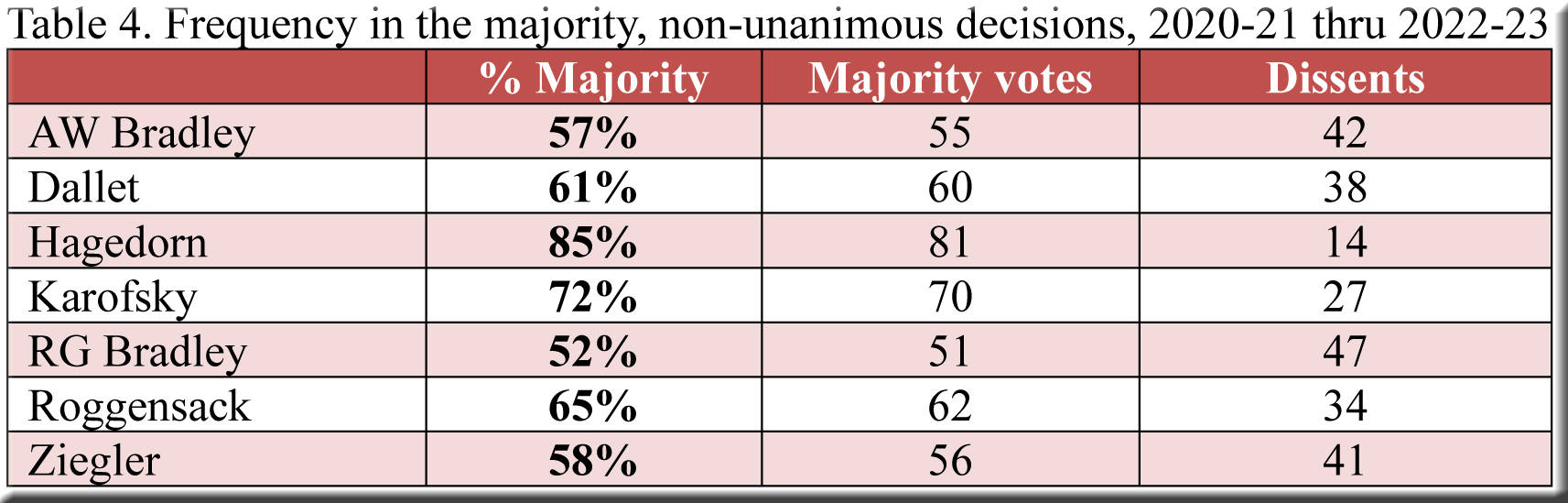
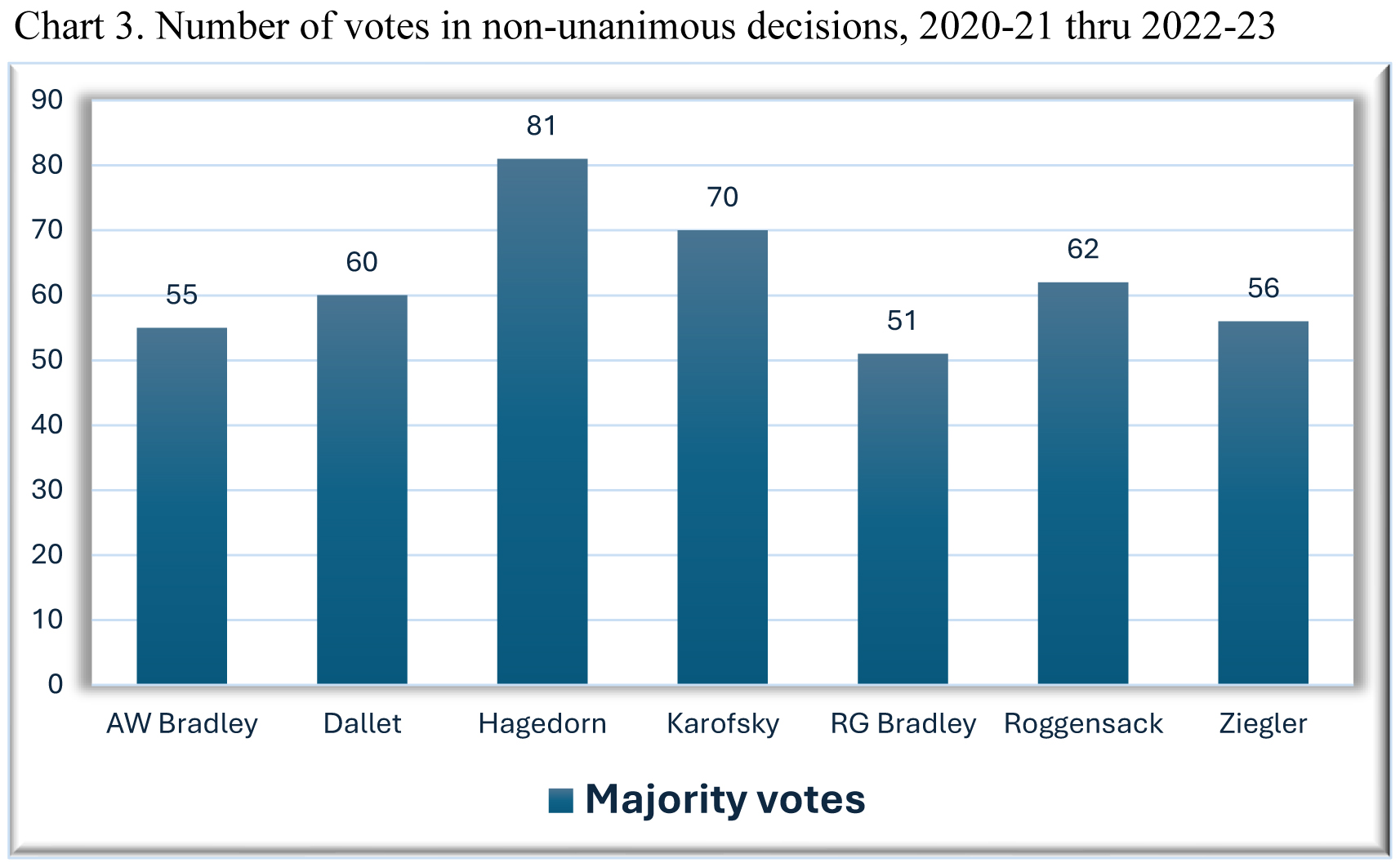
Regarding these non-unanimous decisions, Justice Karofsky appeared in more majorities than any of the three conservatives, and Justice Dallet did so more often than either Justice Ziegler or Justice RG Bradley. Evident in both Table 4 and Chart 3, these outcomes invite contrast with Table 1 and Chart 1.
As one might surmise, Justice Hagedorn’s vote became crucial, especially in the most polarized (4-3) decisions, where neither the liberal nor the conservative bloc could prevail without him. He joined 82% of these majorities (Chart 4)—far more than Justice Karofsky, the next most frequent participant at 59%.
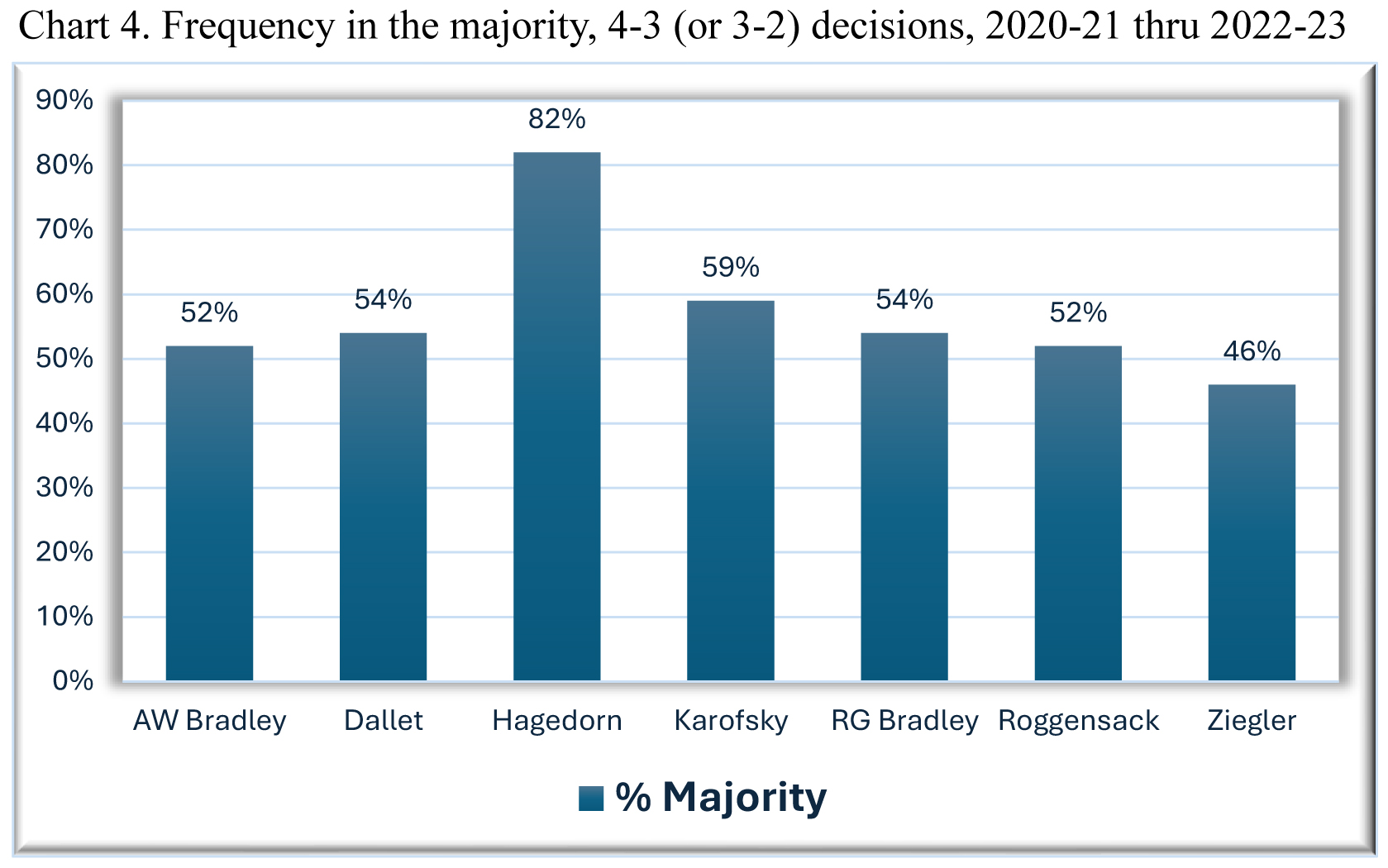
In short, by the last year of this period (2022-23), Justice Hagedorn was siding with liberal justices more often than with conservatives. This signaled an impending eclipse of the conservatives’ golden age, and it would vanish altogether just a few months later.
Liberal ascendance (2023-24 and 2024-25)
When Janet Protasiewicz joined the court in 2023 following the retirement of Justice Roggensack, liberals gained—for the first time—a solid four-vote majority (Justices AW Bradley, Dallet, Karofsky, and Protasiewicz). Indeed, their sway proved all but unshakable, as they managed an even greater degree of voting-bloc cohesion than the conservatives had demonstrated during their own era of supremacy.
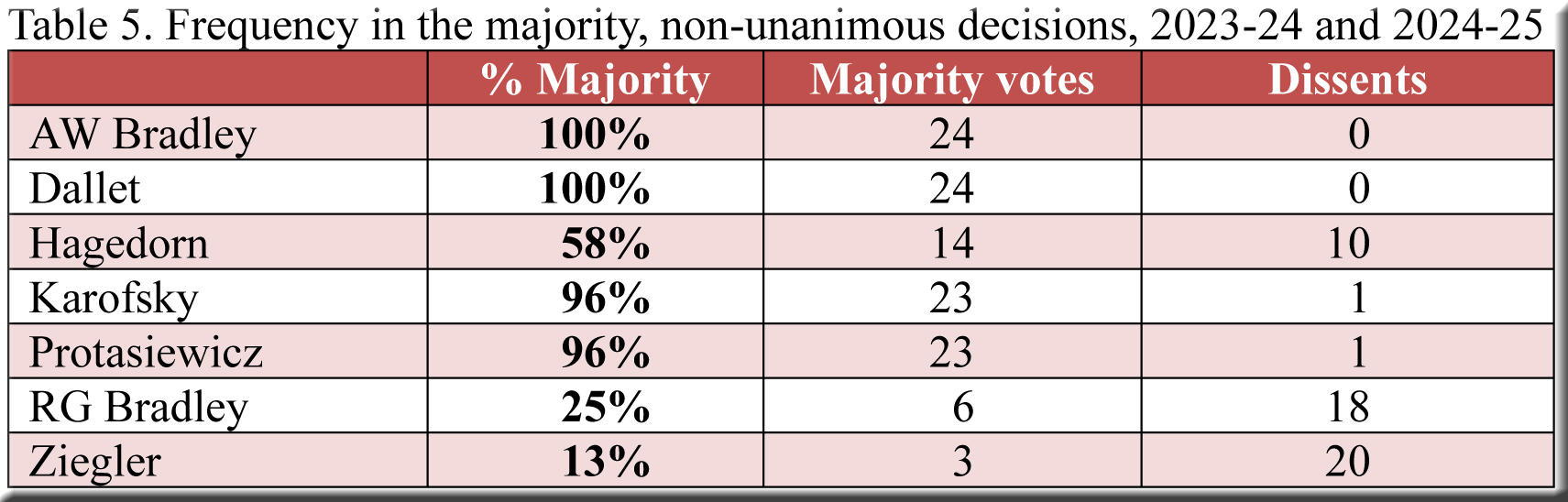
Consider non-unanimous decisions. During the first period under review (2016-17 through 2019-20), Justices Ziegler (89%) and RG Bradley (72%) figured in most majorities, towering over Justice AW Bradley at 37%. Beginning in 2023-24, however, their positions reversed, and the gap between them expanded. Justice AW Bradley’s share soared to 100%, while those for Justices Ziegler and RG Bradley plummeted to 13% and 25% respectively (Table 5). Moreover, in 4-3 decisions the liberals’ dominance became absolute, as they accounted for all the votes in every majority.
Looking ahead
The election this spring to replace retiring Justice Rebecca Bradley should not produce an immediate impact matching that of previous changes in the court’s membership described above. A victory by the conservative candidate (Maria Lazar), substituting one conservative for another, would not weaken the four liberals’ hegemony.[3] And, given the near-total unanimity of this liberal bloc, the addition of a fifth liberal (Chris Taylor) after April’s election would not likely alter the division of clout in Table 5 substantially. At most, an individual liberal might now feel freer to dissent occasionally if the spirit moved, as this would no longer endanger the group’s majority—similar to the breathing room enjoyed earlier by the five conservatives.
[1] Justice Hagedorn, who began his service on the court in 2019, proved to be less staunchly conservative than many had anticipated. Nevertheless, his arrival amounted to a net gain for the conservatives, because he replaced the court’s preeminent liberal, Justice Abrahamson.
[2] The figures do not include several per curiam decisions (nearly all 3-3 splits) and the extremely fractured decision in Service Employees International Union (SEIU), Local 1 v. Robin Vos.
[3] This assumes that the voting pattern of the court’s new member, Justice Susan Crawford, does not depart significantly from that of retired Justice AW Bradley, whom she replaced.
 About Alan Ball






Speak Your Mind