Richard Posner has suggested that one way to perceive the stature or influence of justices is to measure the frequency with which law reviews cite them.[1] This approach highlighted the remarkable sway of Shirley Abrahamson as her career drew to a close—and in 2023 it generated an update comparing the number of references for each of her former colleagues still on the bench. With the passage of three more years and the arrival of new justices, the time has come for another look at how often current members of the court have surfaced in the nation’s law reviews.
The technique
After a search for each justice in Nexis-Uni’s database of law reviews,[2] I weeded out the “false positives”—articles citing other people sharing a justice’s surname. Most justices did not yield a massive number of hits (fewer than one hundred), making the hunt for “false positives” manageable. However, for a long-tenured justice (Ziegler) or especially one with a familiar surname (Bradley), the staggering volume of hits required processing with Posner’s technique described in the note below.[3] Given that the court’s newest justice (Susan Crawford) has not yet been furnished a reasonable opportunity to leave traces in law reviews, she is omitted in the following tables.
Citations of opinions
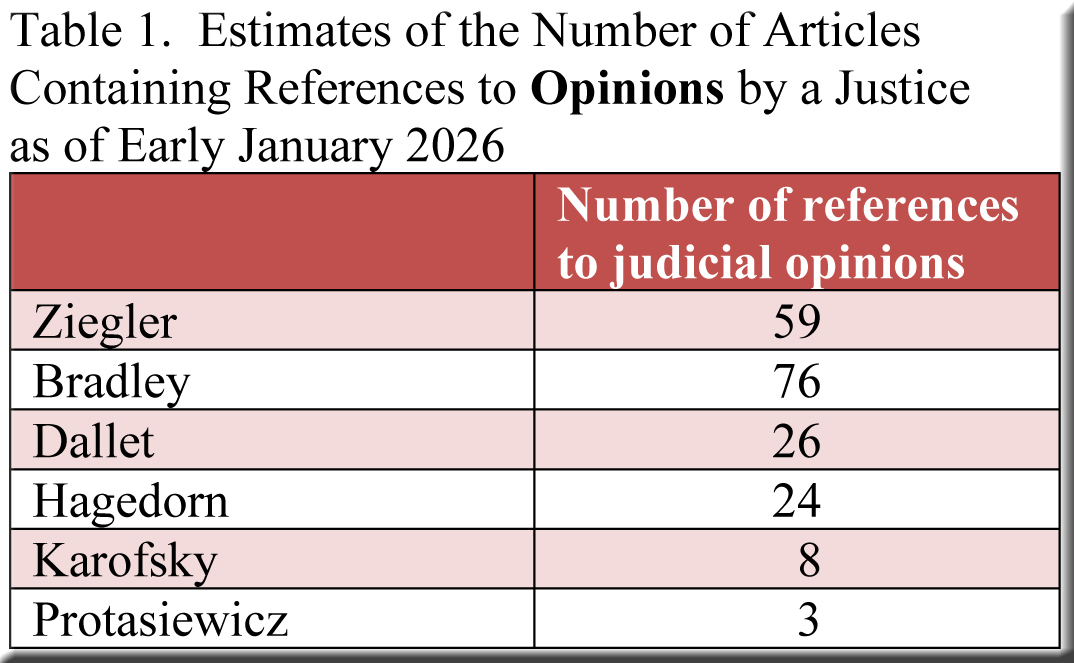
Table 1 concerns the most common type of citation—references to a majority opinion, concurrence, or dissent authored by each of the justices.[4]
Citations of articles
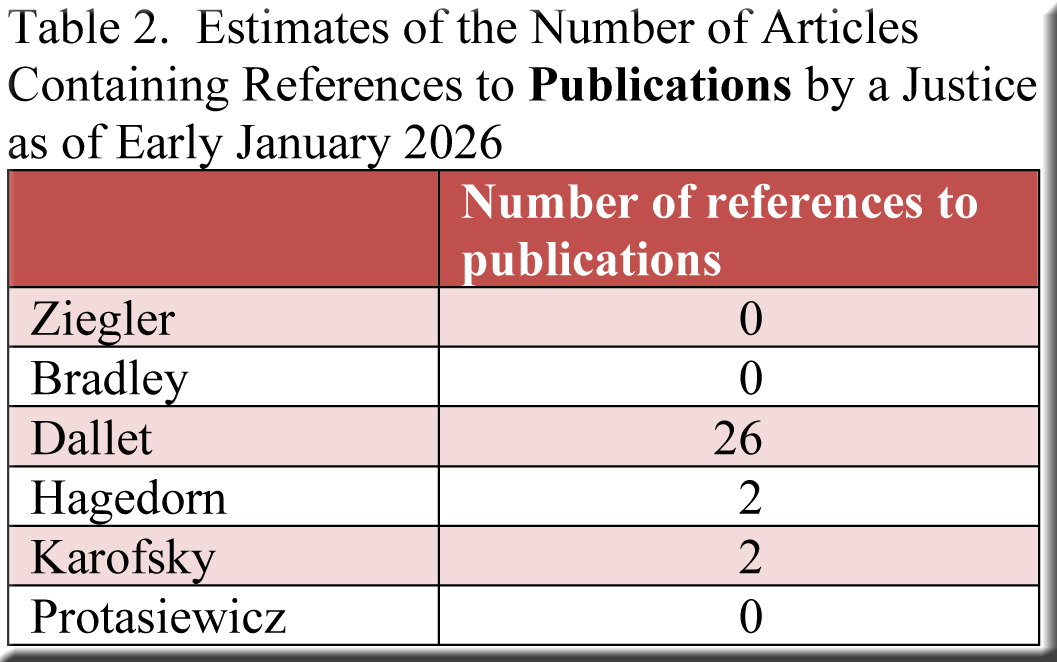
Table 2 pertains to the justices’ published articles.[5] Nearly all the hits are references to these articles provided by other authors, though on rare occasions the hit proved to be a justice’s article itself.[6] Given that all justices write majority and separate opinions, it is no surprise that the largest numbers in Table 1 are associated with the longest-tenured justices. This is not the case in Table 2, dominated by Justice Dallet, which demonstrates that most current justices—veterans and newcomers alike—compose few if any scholarly articles.
Adjusting for longevity
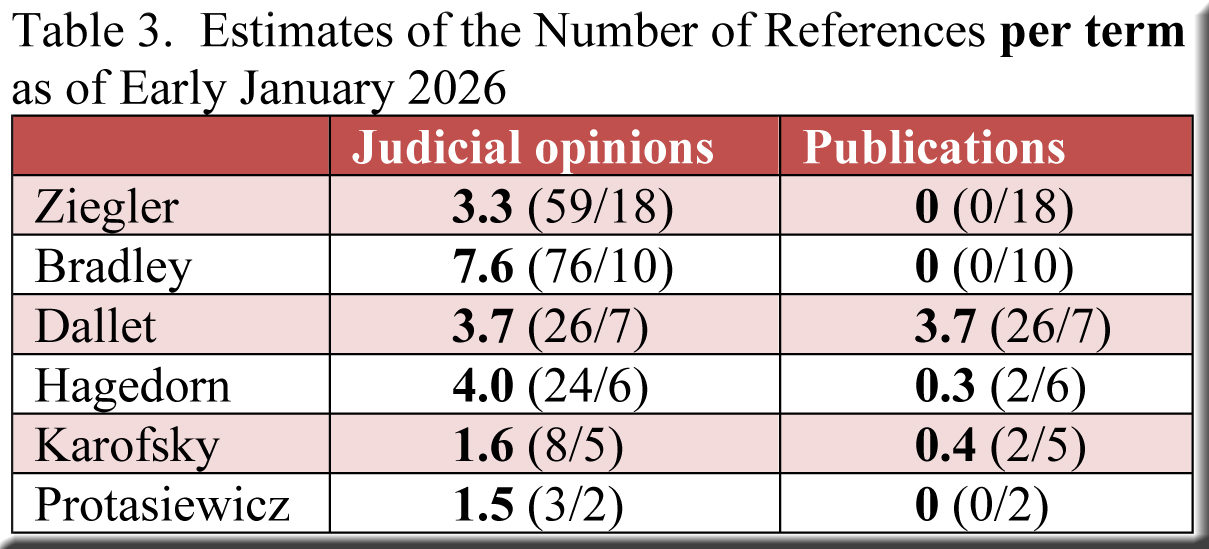
Because the justices’ service ranges all the way from two terms (Protasiewicz) to 18 terms (Ziegler),[7] consideration should be granted to the fact that the court’s veterans have had the most years to accumulate hits. Thus, we’ll conclude with Table 3, which recasts the figures in the preceding tables as per-term averages—and creates a different hierarchy of the justices’ prominence.
[1] See Richard A. Posner, Cardozo: A Study in Reputation (Chicago: University of Chicago Press, 1990). I am grateful to Bill Tyroler for bringing this book to my attention.
[2] I submitted the following search string to Nexis-Uni for each of the justices: “Surname, supra” OR “Surname, J.” OR Firstname w/3 Surname OR Justice w/3 Surname.
[3] Let’s say that Justice X’s surname generated a raw total of 2,000 hits. If scrutiny of a random sample of 100 of these hits found that 4% of the 100 sampled articles referred to Justice X, we would estimate that 80 of the 2,000 articles (4% of 2,000) cited Justice X. The sample sizes that I used are a larger portion of a justice’s total number of hits than was the case in Posner’s work.
[4] Excluded are references to the justices’ political campaigns, quotations from media interviews and oral arguments, and biographical information (such as the year a justice joined the court). This is slightly more restrictive, and with a smaller gray area, than the criteria employed in the 2023 post.
[5] This category also includes references to formal public events—addresses by justices, for instance, and awards bestowed on them (which figured in the post on Justice Abrahamson)—but there were virtually no such hits among the data in the current post.
[6] One should bear in mind that for justices whose surnames yielded large numbers of hits, the figures in Table 2 are estimates derived from random samples, as explained above. If such a justice wrote an article that has rarely been cited, it could elude the random sample.
[7] These figures do not include the current (2025-26) term, whose output could not possibly have appeared yet in law-review analyses.
 About Alan Ball






Speak Your Mind